TWO TOMORROW'S SECTIONS
The works to realize what is going to be a new technologic wonder on Aosta Valley mountains, started in April 2011. That will be a worldwide worth engineering masterpiece, showing up brand new for the opening ceremony in 2015!
It will be an amazing ropeway wich is going to be one of the star touristic brands both for Courmayeur and for the whole Aosta Valley. “Skyway Monte Bianco”– the new name of the ropeway – is going to be a new system, perfectly integrated within the environment.
The new ropeways and stations are a new archtecture and engineering concept. The project aims to amaze visitors through the use of technology, but focusing on Mont Blanc landscapes.
The new ropeways system is owned by Regione autunoma Valle d’Aosta and it is managed by the society Funivie Monte Bianco spa. The project execution, basing on a frame contract which was subscribed in 2004 by the Regional government, the Courmayeur municipality and Funivie Monte Bianco spa, implies an overall investment amounting to over 100 milion euros and requiring 5 years of construction works in extreme environment.
The new ropeway will be composed by two cableway segments and three stations: departure point in Pontal d’Entrèves, intermediate station at Pavillon and arrival in Punta Helbronner, at 3462 m a.s.l.. The new ropeways system will substitue the three old cableways, which will be completely removed at the end of the construction works.
The new ropeways, which are expected to open in late spring 2015, were designed by a team of engineers, architects and geologists, lead by the society Dimensione Ingenierie srl. The architectural shapes were designed by architect Carlo Cillara Rossi. The construction works are executed by Cordée Mont-Blanc consortium, on a Dopplemayr Italia ropeway trademark technique. The project was conceived especially focusing on environmental impact, technology innovation and research, energy saving and use of renewable energy sources.
All the project is based on very high design standards, in order to minimize the energy use for heating and cooling. The presence of high efficiency heat pumps and large photovoltaic surfaces, make all the system free from traditional fuels, a part from the emergency back up power engines. Along with the ropeways, it will be realized a new water providing and sewage sytem for the Pavillon area and a complete water depuration facility for the Punta Helbronner station.
The new ropeways will get over a total drop of over 2000 meters, taking skiers and hikers from the Entrèves village (1300 m a.s.l.) up to Punta Helbronner (3462 m a.s.l.), with a daily capacity of about 3000 people.
The three stations are newly built, using mainly concrete, steel and glass, and they will have wide panoramic areas. The cable cars will be spherical, completely surrounded by glass and self-rotating, aiming to amaze guests and visitors, by exploiting not only the technology but, mostly, the natural Mont Blanc scenarios: the rotating cable cars will actually allow visitors to enjoy a 360 degree view of all the surroundings.
At Punta Helbronner (3462 m a.s.l.) there will be a round terrace having a 14 meters diameter: from there you can enjoy a 360 degree view on the top of Mont Blanc (4810 m a.s.l.), on Dente del Gigante and on the extraordinary Vallée Blanche. An adequate path will lead you to go on, prosecuting your trip to the French town Chamonix-Mont-Blanc.
TOMORROW'S STATIONS
Pontal d'Entréves
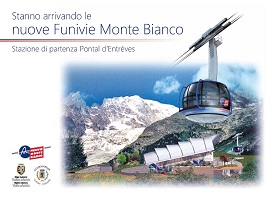
The new bottom station will be situated in Pontal d’Entrèves, close to the Val Veny cableway and near by the Italian side of the Mont Blanc tunnel and the end of A5 motorway.
The wave curved roof design provides to the building a modern and aerodynamic look, connecting and smoothly merging into the local morphology.
The imposing building will be surrounded by a green framework area and will welcome the tourists with any comfort: there will be wide outdoor and underground parkings, hosting up to 350 cars and 10 coaches; information desks, bar and sickroom, the ticket offices and the technical spaces where are set the powerful engines that will push up the futuristic cable cars.
Pavillon du Mont Fréty
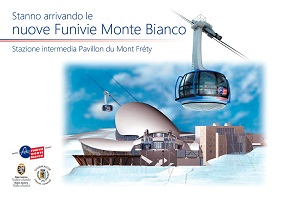
The first station you’ll face while going up will be, same as now, at Pavillon du Mont Fréty: the building will have wide glass surfaces, supported by fine steel obliquous frame structures, providing visitors with a panoramic scenario on the Val Veny and Val Ferret slopes and enhancing the imposing drop up to Mont Blanc.
The building is covered with a wide wing curved roof and on its western part, which is oriented towards Mont Blanc, it will host many spaces devoted to the visitors, all integrated and connected by a path crossing the commercial areas, the 147 seats conference and cinema hall, the two restaurants and bar, ending to the old cableway station, which is going to be renovated and converted to a museum exposition area. The indoor paths allow an easy visit, and a lift or starways served connection from the different boarding levels. There will be as well outdoor paths, getting you to the nature, to the botanic garden and to the solarium.
Punta Helbronner
Before exploring further details it must be acknowledged that the present Rifugio Torino station is not going to be a ropeway station anymore. To reach this mountain hut there is now a huge concrete well, 90 meters deep and containing two lifts, which are connected to a 165 meters horizontal tunnel, digged inside the mountain bedrock. This new “subway” will take visitors directly to the new Rifugio Torino, which is not far from the old one, and is connected to it through a steel 200 steps stairway.
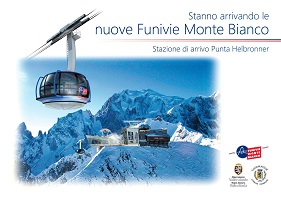
On the top station of Punta Helbronner, at almost 3500 m a.s.l., there will be a panoramic terrace, having a diameter of 14 meters and allowing visitors to enjoy an amazing 360 degree view on the top of Mont Blanc (4810 m a.s.l.), on Dente del Gigante, on the Grandes Jorasses and on the extraordinary Vallée Blanche. This terrace, located on the roof of the station, will be as well used, in case of emergency, as a landing platform for helicopters.
Being the available spaces very narrow, the station is mostly extended in the vertical direction and through cantilevered terraces.
On the western side of the station there is the big panoramic dome facing the Mont Blanc, the absolute focus point of the building, equipped for multi-modal public information and locating the crystals museum. At the upper floors there will be the self-service restaurant, with a great view on the Mont Blanc and a door straight to the terrace, just by the peak which marks the border between Italy and France. On the eastern side of the station, just in front of the Grandes Jorasses, there are the bar and the path leading to the departure of the French “liaison”.
THE CABLE CARS
The cable cars will be spherical shaped, without edges and corners, being designed on a ultra-modern approach, seeking for the maximum energetic and structural efficiency.
The cable cars will be able to host 80 people (instead of 20, as it is at present) and will rotate, making a 360 degrees turning during the way. They will have wide windows, equipped with a heating system, in order to avoid steaming and freezing; likewise, special sensors located under the floor will avoid icing.
The cable cars will be equipped with LED lights and multimedia information systems (tv and monitors showing docs and news about the surrounding environment). Put together with the amazing windows, you’ll enjoy a unique and impressing experience!
SOME FIGURES ABOUT THE WORKS
The construction works requires the use of 35.000 meters of concrete and 5000 tons of steel; the eight track ropes have a total length amounting to 18.000 meters and a weight of 400 tons.
Four working ropeways and six cranes provide everything is needed for the works.
It’s not easy to work on Punta Helbronner construction site: workers stay at night at Rifugio Torino and constantly turn over on 7 working days + 4 rest days, in order to compensate the stress and have sufficient recovery. They are subjected to frequent medical visits and test at the Aosta High Mountain Medical Centre.
Workers must also attend specific courses, held by doctors and rescuers. The working sites are equipped with winch operating oxygen, defibrillator, stretcher and sick room box.
The project, the working site, the state of the works, many pictures and movies and a press review are available on the internet site:
Nuove Funivie del Monte Bianco