Invest in the Aosta Valley
Naturally directed towards environment and tourism, the Aosta Valley is going to become the ideal place for innovative technologies development and spread, playing on the environmental heritage and on its morphological, climatic and biological variety, and having a positive impact on security levels, protecting the territory and its accessibility. Moreover, it aims at taking the central place inside the research and technological development system.
Some technology platforms, on which the Region has planned short, medium, and long-term investments, have been highlighted. They mainly concern four sectors:
-
Technologies for monitoring and territorial security
-
Renewable energy and energy saving
-
Technologies for environmental protection and reintroduction of ecosystems
-
Electronics - Microelectronics - Microrobotics - Mechatronics
The Region turns its attention abroad, to new enterprises and research centres installation, which can produce benefits in terms of knowledge, competitiveness, employment and innovation. At home, thanks to its small size and its economic and legislative autonomy, institued more than sixty years ago, it's possible to establish direct relationships with the Public Administration, which means: simplified bureaucracy, procedural efficiency, quickness in taking decisions and in circulation of information.
At the junction of the main roads that connect Italy to France (through the Mont Blanc and the Piccolo San Bernardo tunnels) and to Switzerland (through the Gran San Bernardo tunnel), bordering with Piedmont, the Aosta Valley is a mountain region at the foot of the highest European mountain. It enjoys a competitive, strategic and favourable logistical position (300 km from Lyon and 150 km from Geneva, 100 km from Turin and 180 km from Milan), in the middle of the most important Italian and European development centres.
Playing an active part in the European Community, in July 2007, the Aosta Valley joined the "Eurorégion Alpes-Méditerranée", together with Piedmont, Liguria, Provence - Alpes - Côte d'Azur e Rhône - Alpes, sharing and supporting the common purposes of promoting economic development, transports improvement, co-operation on research, university, tourism and environment.
The economic system benefits from a diversified economy, based on the industrial sector (small and medium-sized businesses, which include some local successful enterprises, and large international companies), on hydroelectric power production, tourism and agriculture. As a result, the economic, social and environmental welfare is an important key factor.
The gross domestic product has lightly increased during the last years, as well as the value added. Gross domestic product per capita (euro 34.000 in 2007) ranks the Valley at the fourth place in the Italian list, and at the top as regards household expenditure.
The rate of inflation is below the national average and positive results are achieved by the export activities.
The rate of unemployment is about 3%.
|
|
2000 |
2001 |
2002 |
2003 |
2004 |
2005 |
2006 |
|
Gross domestic product |
3.224,9 |
3.352,3 |
3.508,0 |
3.664,8 |
3.844,0 |
3.918,9 |
4.059,8 |
|
GDP per capita |
27.077,4 |
28.076,4 |
29.185,0 |
30.162,9 |
31.379,5 |
31.757,5 |
32.635,1 |
Source: ISTAT
The Aosta Valley boasts enterprises operating in several sectors (from tourism to steel industry, from electronics to microsensors technologies, from security and food industry), several successful businesses, innovative industrial activities supported by the regional business incubators (hosting above all enterprises belonging to the information technology and supplying them with important services), international companies investing in research centres and productive activities.
The regional education system is made up of various high schools (among others technical, scientific and professional ones), boasting the largest number of students per class compared to the national average, and two Universities: Politecnico di Torino, with its new teaching campus settled in Verrès (scientific-technological degrees) and Università della Valle d'Aosta (economic-financial and socio-pedagogy degrees).
The Politecnico di Torino organizes mechatronic and computer engineering courses, whose didactic activities concern, for the most part, electronics, computer engineering, telecommunications, data transmission and automation. The University plays an important role not only for its prestige as a didactic centre: it promotes initiatives aiming at supporting the regional productive structure through co-operation on industrial research and providing technology transfer support. Besides, the spin-offs settled in the Technological Pole can benefit from assistance in obtaining patents and in licensing.
The Università della Valle d'Aosta, recently founded, organizes courses in several branches, such as political sciences, economics, psychology, social and linguistic sciences. Students can also attend postgraduate courses.
The University aims at favouring the entry of students into the working system, through formal agreements with regional, national and international enterprises and organisations offering the opportunity for training. Internationalisation is one of the University's purposes: the Institute takes part in the Erasmus program and in other European programs and it establishes relationships of co-operation with some foreign Universities.
TheInstitut Agricole Régionalcarries outboth didactic activities and researches in agricultural field, operating autonomously or together with some national and European research centres.
Some world-famous research centres are settled in Aosta Valley. They carry out researches in several sectors such as renewable energy, microbototics, computer engineering and wireless sensor technologies. Mostly private, they can enjoy the participation of some important research institutes, as for example the ISMB - Istituto Superiore "Mario Boella", partner with the Region in the hydroelectric energy production research.
Thanks to its favourable geographic position and to the Italian/French bilingualism, the Region can easily cooperate with some important industrial districts, technological parks, university poles and research centres settled in France, Switzerland and Piedmont.
As far as the technological infrastructure is concerned, the Aosta Valley belongs to the TOP-IX consortium, which manages the NAP (neutral access point), a point of the Internet web connecting different telecommunication operators in order to exchange Internet in the North-West Italy area. The aims are to develop and promote some innovative projects concerning broadband Internet access.
Nowadays, some regional structures, as for example the two business incubators inside the industrial areas of Aosta and Pont-Saint-Martin, equipped with the "E-center" (advanced computer points) and wired to the optical fibre, benefit from high-level ICT services at the enterprises and citizens disposal even in territorial areas far from the central ones (i.e. Isole Polifunzionali in some lateral valleys).
As regards the digital switchover, the Aosta Valley is a pilot region, being the second "all digital" region in Italy. The project All Digital Vallée d'Aoste, in collaboration with the Ministry of Communications, is oriented towards the creation of a regional network supplying broadcasting and data transmission services, according to the characteristics of the mountain region. Since April 2007, Aosta and the neighbouring districts are able to receive the digital signal, and the same will occur in the other districts from April 2008. Broadband Internet access and digital services, together with innovative technologies experimentation (Wi-Fi, Hyper-LAN, Dtt) are between the most important regional purposes.
Besides the technological services, the enterprises settled in the Aosta Valley can benefit from other services offered by the business incubators (Pépinières d'entreprises). They are innovation tools for economic development aiming at favouring the creation of new innovative businesses, ensuring a set of fundamental services and a range of integrated strategic guidance. The two regional incubators, located one in Aosta, the other in Pont-Saint-Martin, are designed for temporary accommodation (for a maximum period of 5 years) of new businesses, which stand out for:
-
the innovative nature of their products and/or processes;
-
implying no dangerous environmental impact;
-
the maximization of the exchange and markets opening opportunities;
-
the high quality of their professional figures;
-
the expected profitability
Struttura Valle d'Aosta S.r.l. owns and manages several regional industrial buildings as well as the business incubators and the industrial areas (Espace Aosta, in Aosta and Ex Ilssa Viola, in Pont-Saint-Martin). The society offers strategic guidance, real-estate management, common and centralized services, which represent an important opportunity for entrepreneurs wanting to start their business in the Region.
Besides Struttura Valle d'Aosta, the Chambre valdôtaine des entreprises et des activités libéralescontributes to the local economic development through guidance and promotion of entrepreneurship, as well as Finaosta S.p.A., which supports entrepreneurial activities through financial and consulting interventions (access to loans, leasing, etc).
The Agenzia del Lavoro di Aosta helps enterprises in manpower research, organizes vocational training activities and offers advices concerning economical incentives.
The highest European mountains, ski runs about 850 km long, a natural park (the National Park of Gran Paradiso, founded in 1922), where several protected species live, represent the key factors of the Region, which offers the residents and the tourists various opportunities to leisure, relax and practice sportsin the open air. Paths and mountain refuges, downhill skiing, alpinism, rafting, climbing and trekking, are only some of the activities at one's disposal not far from the town centre.
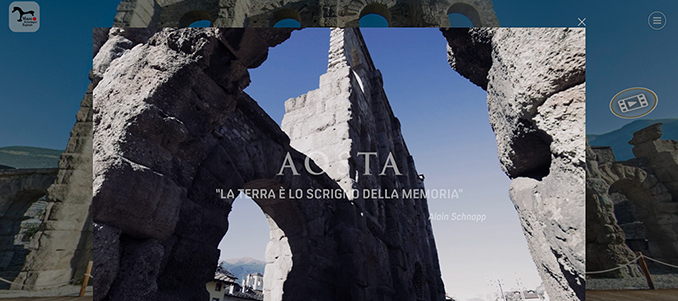
The Aosta Valley has an ancient monumental heritage, rich in archaeological ruins dating from the pre-historical age, roman vestiges (it was conquered by Romans, who founded Augusta Praetoria, in 25 B.C.), and medieval and renaissance castles (because of its strategic position, it was important for the control over the strategic tunnels).
Fairs and feasts originate from the strong regional folklore, the handicraft patrimony and the gastronomic tradition; the ancient atmosphere, the customs and the local traditions are, in this way, still alive.
Among the cultural events, the Saison Culturelle organizes concerts, plays and showings.According to the Special Charter, the French language is the official language as well as the Italian one. Therefore, the official records of the Public Administration proceedings can be written in both idioms. Bilingualism plays an important part in education, because French is taught since the first classes. Students have in this way a perfect linguistic knowledge of French, which is extremely important when they enter the job world. Through agreements between the Region and international organizations, students have the opportunity of obtaining qualifications recognized by the European Community (i.e. Diplôme de la Chambre de Commerce et d'Industrie de Paris, Esabac program).
| Service realized in the framework of the initiative "Sviluppo Industriale - sistema Valle d'Aosta" promoted by the Productive Activities Councillorship and co-funded by the FESR in the framework of the POR Regional Competitiveness 2007/2013 |